
Identification and taxonomy
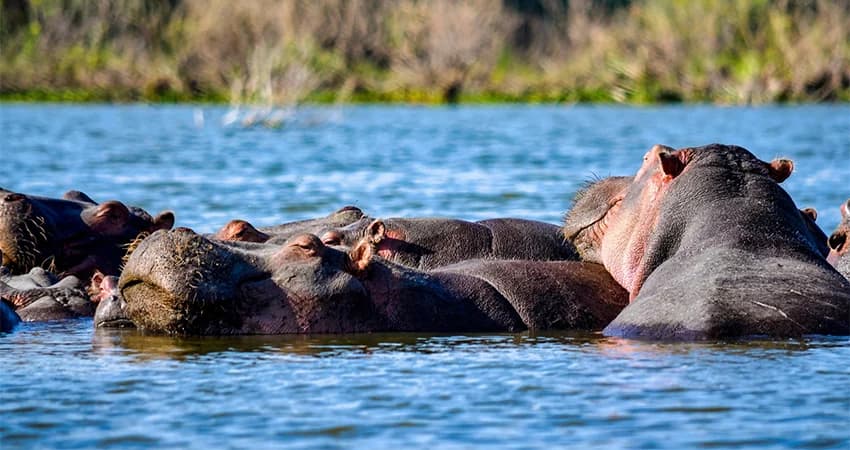
- Eyes, ears and nostrils sit high on the head, allowing a hippo to monitor its surroundings while largely submerged. Source ↗
Diet, social life and activity
- Common hippos mainly graze on land, often seeking short grass near water but sometimes traveling farther to forage. Source ↗
- Hippos gather in water; dominant males defend access to areas and females, while subordinate males may also be present. Source ↗
- Calls include grunts and wheezy honks; a wide-open mouth can form part of a threat display. Source ↗
Conservation and evidence
More field context
- Hippos use rivers and lakes, spending much of the hot daytime in water and coming ashore to feed at night. Source ↗
- In water, hippos can move by pushing from the bottom or walking along it; their aquatic appearance should not be described as fish-like swimming. Source ↗
- The reddish skin secretion sometimes called blood sweat is not blood; it helps protect the skin. Source ↗
Photographing and watching responsibly
A distant or partly submerged hippo can still make an informative image. Follow the operator’s position and do not approach a bank or block an animal’s access to water for a closer view.
Choose a route that gives you time in suitable habitat and keep the day worthwhile even without a sighting. Activity patterns describe tendencies, not an appointment. Stay within the area and hours permitted by the park, follow the guide and never feed, call or provoke an animal for a response.
Photography and wildlife etiquette →Is a hippo in the water harmless to people nearby?
No. Water does not make the animal safe to approach. Use the designated viewing arrangement and follow the guide or boat operator’s instructions.
Are sightings guaranteed?
No. A park listing or conservation record establishes context, not the location of an animal during your visit. Weather, habitat, animal movement and access affect what can be observed. We do not promise a sighting, hunt, birth or other behaviour.
What to keep in mind
- This is not the pygmy hippopotamus, which is a separate species.
- No wildlife-viewing approach distance or boating safety guarantee follows from these behavior notes; use the relevant operator/ranger rules.
- SDZWA’s public animal-page scientific-name spelling is erroneous (amphibious); this register retains the accepted Hippopotamus amphibius. Its disputed superlatives and speculative relatedness wording were not adopted.
Sources reviewed . Conservation assessments retain their original dates; a review date does not mean the species was reassessed that day. Next editorial review due: May 2027, sooner if a cited assessment changes.
Where to look on our safari routes
These parks and landscapes have documented records of this animal. Use the links to compare habitats, overnight locations and routes. Local conditions and animal movement still determine what you see.
Maasai Mara
The Triangle checklist records elephant, buffalo, black rhino, common hippo, white-bearded wildebeest, common zebra and Masai giraffe.
Use the reserve checklist to understand the range of wildlife, rather than as a promise of sightings. Some names in older checklists differ from current species classifications.
Official or conservation source ↗Ol Pejeta
Ol Pejeta lists these predators, elephants and hippos among its wildlife.
Use the conservancy’s current visitor information when planning activities. Older population counts cannot predict how many animals will be visible during your visit.
Official or conservation source ↗Lake Manyara
TANAPA names elephant, lion, buffalo, zebra, wildebeest, giraffe and hippo in Manyara’s habitats.
Tree climbing is a known lion behaviour here, but it is not a promised sighting. A rewarding visit can also focus on the park’s varied habitats and other wildlife.
Official or conservation source ↗Ngorongoro
NCAA’s crater description names elephants, Cape buffalo, hippos, black rhinos, lions and wildebeest.
These records describe the crater’s wildlife. Keep crater-floor viewing separate from plans for the wider conservation area and its seasonal herds.
Official or conservation source ↗
Journeys through relevant habitat
These routes visit destinations supported by the presence sources above. They are general safaris, not guaranteed species encounters.